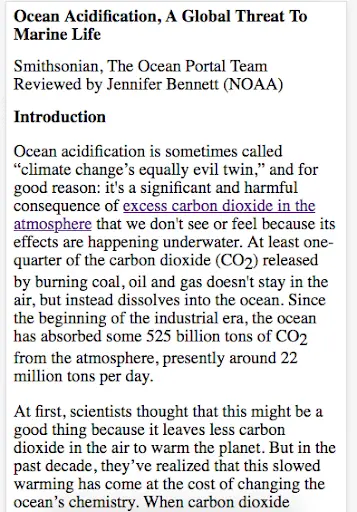
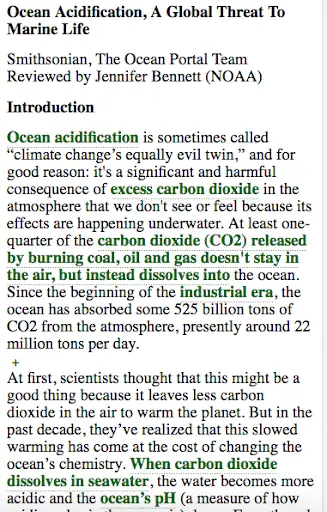
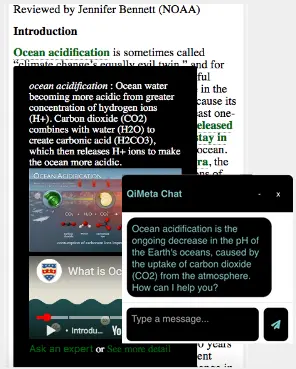
Ocean Acidification – QiMeta in Action
Explore how QiMeta transforms an original article into an interactive, AI-powered learning experience with highlights and engagement tools.
Why should I use QiMeta? Watch the “Why QiMeta?” video: https://qimeta.ai/videos/qimeta_why.mp4
How do I get started with QiMeta? Watch the “How to get started” video: https://qimeta.ai/videos/qimeta_get_started.mp4
Our Solutions
QiMeta adapts the same reading to the person reading it — from first sounds in Kindergarten to research papers at work. Choose your setting.
Teachers deploy the MTSS three-tier reading strategy inside one class: the same science or story concept at grade level, one year below, and two years below with Phonics support. Every student learns the same idea, and the teacher can see who needs help with which sounds.
Sound boxes (s·ee·d), each sound, slow blending and say-the-word, following the UFLI phonics sequence. Heart words ♥ and new parts ★ are marked.
The same concept written at grade level, one year below, and two years below, so Tier 1, 2 and 3 readers work on the same lesson together.
The Reading Help view places each student at Independent, Some support or Needs help, and lists the hardest words and patterns to reteach for small groups.
“Read the sentence” lights up each word as it is spoken. Sounds can be recorded by your own teachers, and no student audio is recorded.
A 3rd-grade class, one concept, three versions.
Upper elementary and middle school is where reading shifts from learning to read to reading to learn. QiMeta keeps students inside the text with help pitched to their grade, instead of sending them off to search or to a chatbot.
Difficult words, names and key facts are highlighted with short definitions written for the reader's grade.
Highlight the same article for different reading levels, so students who read below grade can still take part in the lesson.
Diagrams with ConceptCanvas, embedded videos and voice read-aloud support visual and auditory learners.
One-click quizzes from the reading, plus Focus Scores that show the teacher how carefully each student read.
High school students have AI everywhere. QiMeta gives them help that stays tied to the reading, so the effort of understanding stays with the student — and teachers can see that it did.
Students ask questions about the reading and get answers drawn from the document, not a shortcut around it.
Definitions and key facts support comprehension while the student still does the reading and reasoning.
Multiple languages and voice read-aloud help English learners work with grade-level science and social studies.
Practice and assessment tests from any document, with focus and engagement reports per student.
Upload lecture slides, textbook chapters and PDFs. QiMeta highlights the terms and facts that matter for this course and this student, and gives instructors a view of engagement before the exam does.
PDFs, slides, Word documents, web pages and scanned pages become AI-enhanced readings.
Technical terms, names and key facts are defined from the perspective of a first-year or advanced student.
Generate practice tests from the reading, and keep Mental Notes alongside the text.
See who read, how closely, and which terms students looked up most.
Researchers, clinicians and analysts read outside their specialty every week. QiMeta turns a research paper into an annotated reading, so you can follow the methods and findings without stopping to look up every term.
Highlighted terms, acronyms, names and key findings, defined for a professional reader.
Ask about methods, results or limitations and get answers grounded in the paper itself.
Highlight any web page from the QiMeta Chrome extension, or upload PDFs directly.
Mental Notes keep your thinking attached to the exact passage for later review.
Trenton alone has over 5,000 unfilled jobs, and many adults read below the level their training materials assume. QiMeta helped nursing students at Capital Health master complex material and improve focus — the same approach works for any credential program.
Deployed with nursing students at Capital Health to master clinical terminology and complex readings.
Definitions pitched to the learner make technical training material accessible without watering it down.
Trainers and employers track engagement and assessment results to target support early.
AI handles the explanations and quizzes, so scarce instructors can focus on coaching.
Explore presentation slides on radiation and biology.

Discover the mathematical secrets behind Egypt’s pyramids—and how triangles shaped history.
Learn about Earth's water cycle from an elementary student's perspective.
Uncover how plants transform sunlight into energy—fueling all life on Earth.
Learn the essentials of radiation and how it can effect our biology.
See how climate change impacts Hawaii’s islands—and what the future may hold.
A picture is worth a thousand words. Learn how to understand concepts through diagram and image using QiMeta ConceptCanvas.
Try QiMeta ConceptCanvasAt QiMeta, we’re reimagining education for the AI era. Our mission to empower students by building lasting knowledge and developing critical thinking is at the heart of our research. We recognize the growing risks that come with introducing AI into education, particularly the danger of AI dependency that can undermine independent thought. That’s why our work focuses on designing AI tools that support, rather than replace, the learning process.
What have we learned from watching real readers use QiMeta? How AI-assisted tooltips and definitions can strengthen focus, understanding, curiosity, and long-term retention without replacing the thinking required to learn.
Explore how contextual vocabulary support can help learners stay focused, understand increasingly difficult material, and preserve the cognitive effort required for learning.
QiMeta can have a positive societal impact on addressing literacy. We’ve developed a platform that not only encourages deeper engagement but also addresses the fundamental societal challenge of low literacy and its widespread impact on communities around the world. By making complex content more accessible and interactive, we aim to improve focus, deepen understanding, increase satisfaction, and help learners thrive in an AI-driven world, equipped not just with answers, but with the ability to think critically about them.
of U.S. adults read below a 6th-grade level, affecting daily tasks including reading instructions, healthcare comprehension, and even voting. Individuals with low literacy skills are more likely to be unemployed or underemployed, perpetuating a cycle of poverty and economic disparity.
projected teacher vacancies by 2025, particularly in essential subjects like math, science, and special education. This compromises the quality of education and leaves the workforce ill-prepared for the demands of the job market.
unfilled job positions in cities like Trenton, NJ, contributing to an annual loss of up to $2.2 trillion nationwide.
QiMeta is a research platform to improve the effectiveness of existing knowledge content. It takes any web article and creates an annotated version highlighting key concepts and providing easy-to-understand definitions, illustrations, and videos. Our goal is to improve understanding by 10%, in 10% less time, with 30% increased satisfaction.